Posts

Schools and universities have never been shy about embracing technology. From virtual learning environments to AI-powered study tools, education has a long history of adopting innovations that promise efficiency and convenience. Few technologies illustrate this quite as well as biometrics.

After all, forgetting a password is inconvenient. Forgetting your fingerprint? That’s considerably more difficult.

As biometric systems become more common across educational settings, educators have an exciting opportunity to explore technologies that can make daily routines smoother, more secure, and more efficient, while ensuring privacy remains front and centre.

What Exactly Is Biometric Data?

Biometric data refers to information derived from an individual’s unique physical or behavioural characteristics that can be used to identify them. Common examples include fingerprints, facial recognition data, iris scans, voice recognition, and even behavioural traits such as typing patterns.

Under UK GDPR, biometric data used for the purpose of uniquely identifying someone is classified as special category data, meaning it receives additional legal protection.

This special status reflects the unique nature of biometric information. Unlike a password or ID card, biometric identifiers are intrinsically linked to an individual, making it especially important that they are handled responsibly.

Where Are Biometrics Appearing in Education?

The stereotypical image of biometrics in education is the fingerprint scanner at the school canteen, but the reality is much broader.

Schools, colleges, and universities may use biometric systems for:

  • Cashless catering and meal purchases
  • Library borrowing and returns
  • Student registration and attendance monitoring
  • Building or room access control
  • Printing and photocopying services
  • Secure access to examinations or specialist facilities
  • Facial recognition for campus security systems
  • Staff access management

For many institutions, the appeal is clear. Biometric systems can speed up routine processes, reduce reliance on cards and passwords, minimise administration, and improve user experience. A lunchtime queue moving at record-breaking speed can be a win for students, staff, and catering teams alike.

These efficiencies explain why the technology continues to gain traction across the sector. The key is ensuring that innovation is matched by robust data protection practices.

The Legal Basis Question: More Than a Tick-Box Exercise

One of the most important aspects of implementing biometric systems is identifying the correct legal basis for processing.

Under UK GDPR, organisations processing biometric data must identify both:

  1. A lawful basis under Article 6; and
  2. A separate condition for processing special category data under Article 9.

Think of it as needing two keys to unlock the same door.

Example 1: Cashless Catering Systems

A secondary school introduces fingerprint scanners that allow pupils to purchase meals without carrying a payment card.

Possible Article 6 lawful basis:

  • Public task, where the school is carrying out its educational functions.

Possible Article 9 condition:

  • Explicit consent.

Schools in England must also consider the requirements of the Protection of Freedoms Act 2012, including parental notification and consent arrangements for under-18s who use biometric recognition systems. Pupils also have the right to object and must be offered an alternative method.

Example 2: University Building Access

A university uses facial recognition to grant access to a high-security research facility.

Possible Article 6 lawful basis:

  • Public task or legitimate interests, depending on the circumstances and the institution’s role.

Possible Article 9 condition:

  • Explicit consent, or another applicable special category condition where appropriate.

Example 3: Staff Attendance Monitoring

A college implements fingerprint technology for staff time recording.

Possible Article 6 lawful basis:

  • Legitimate interests.

Possible Article 9 condition:

  • A suitable special category condition must also be identified. Organisations should carefully assess whether consent would be genuinely freely given within an employment relationship before relying upon it.

As with most areas of data protection, context matters. The same technology may require different legal justifications depending on how and why it is being used.

Making the Most of Biometrics Responsibly

Before introducing any biometric solution, educational institutions should ask a simple but valuable question:

What problem are we trying to solve?

If the goal is faster catering transactions, improved security, or a more seamless student experience, biometrics may offer a compelling solution. However, institutions should also consider whether less intrusive alternatives could achieve the same outcome.

The ICO recommends assessing necessity and proportionality and considering whether a Data Protection Impact Assessment (DPIA) is required for higher-risk processing activities.

Rather than viewing this as a hurdle, it can be seen as part of good project planning. Building privacy considerations into a project from the outset often leads to stronger, more sustainable implementations.

Building Trust Through Transparency

Every new technology brings considerations, and biometrics are no exception.

Educational institutions should think carefully about:

  • Data security
  • Transparency and privacy information
  • Accuracy and reliability
  • Equality and fairness
  • Data retention and deletion practices
  • Giving individuals meaningful alternatives where required

By addressing these factors early, schools and universities can build confidence among students, parents, and staff while maximising the benefits the technology can offer.

After all, educational institutions occupy a unique position of trust. Students and families expect organisations not only to embrace innovation, but to do so responsibly.

Looking Ahead

Biometric technology is becoming an increasingly familiar part of modern education. Used thoughtfully, it has the potential to make everyday processes smoother, improve security, and free up valuable time for staff and students alike.

The most successful schools and universities will be those that view data protection not as a barrier to innovation, but as an enabler of it. When privacy considerations are built into projects from the outset, institutions can embrace new technologies with confidence, creating environments that are both efficient and trustworthy.

After all, education has always been about preparing people for the future. Biometrics may well be one small part of that future, provided we remember that good governance and good technology make the best classmates.
You’ve probably heard it by now, EdTech is booming. From lesson-planning AI to real-time behaviour tracking, schools across the UK are embracing technology faster than ever. Whether it’s a new learning app or a full-blown Management Information System (MIS), the promise is the same: smarter classrooms, less admin, and happier teachers.

But here’s the thing, every time we bring in a new tool, we also bring in new responsibilities, especially when it comes to data protection. For schools, ensuring any technology used complies with the UK General Data Protection Regulation (UK GDPR) is not just good practice; it’s a legal obligation.

EdTech solutions, especially those powered by AI, often rely on vast quantities of pupil data to function effectively. This may include:

  • Personal identifiers (e.g., name, date of birth, student ID)
  • Behavioural data (e.g., clicks, interactions)
  • Academic records and performance metrics
  • Special educational needs (SEN) information

If not properly safeguarded, the processing of such data can expose schools to legal, reputational, and ethical risks.

Let’s walk through what this means in practice, and how school leaders and Data Protection Officers (DPOs) can make sure their school stays compliant with UK GDPR.

A Quick Story: “We’re Getting a New MIS!”

Imagine this:

A secondary school in Manchester is rolling out a shiny new MIS platform. It promises everything; attendance tracking, timetabling, safeguarding notes, SEND support, and even parent communications, all under one digital roof.

Everyone’s excited. The SLT’s impressed. The IT manager loves the interface. Staff are dreaming of fewer spreadsheets. But then the DPO raises a hand:

“Have we done a data protection impact assessment yet?”

Cue the room going quiet.

This scenario plays out more often than you’d think. New tech comes in fast, but data protection often lags behind, or worse, gets missed entirely. So how do we avoid that?

Step 1: Start with the Right Questions

Before rolling out any new EdTech or AI tool, ask:

  • What kind of data will this tool collect?
  • Where will that data be stored, and for how long?
  • Has the supplier given us a clear privacy notice?
  • Do we need a Data Protection Impact Assessment (DPIA)?

(Hint: if the system processes special category data or monitors students at scale, as most MIS platforms do, the answer is almost certainly yes.)

Step 2: Pre-Vetting Checks – Your EdTech Compliance Toolkit

Whether you’re reviewing a new reading app or a full MIS, these checks will help you make sure the supplier is up to standard:

Data Processing Agreement (DPA)

Every third-party supplier must sign a DPA with your school. It should clearly lay out:

  • What data is being processed and why
  • Who is responsible for what
  • How long the data is kept
  • What happens at the end of the contract

Lawful Basis

Can the supplier justify why they’re processing pupil data? Schools usually rely on public task, but some EdTech tools, especially optional ones, may need consent. Be wary if it’s not clear.

Data Minimisation

Does the tool only collect what it needs? Or is it asking for extra fields “just in case”? Push back on anything that feels excessive.

Hosting and Security

Is the data stored in the UK or a country with an adequacy decision? Ask if they have:

  • Encryption at rest and in transit
  • Access controls
  • ISO 27001 or equivalent certifications
  • A breach response process

Transparency for Pupils and Parents

Can parents understand what data is collected and why? Suppliers should provide plain-English privacy policies, and so should your school.

Rights and Deletion

Can users (or the school) delete data easily if needed? Are retention periods clearly set out?

Step 3: Don’t Forget AI-Specific Risks

AI tools in EdTech often involve profiling or automated decision-making. Before using them:

  • Ask how the algorithms work (and whether human oversight is possible)
  • Check whether the tool could make significant decisions about students, like predicting attainment levels, or flagging safeguarding risks
  • Make sure pupils’ rights under Article 22 (automated decision-making) are respected

Step 4: Review Existing Tools Too

It’s not just about new tech. Many schools have tools they’ve used for years that may no longer meet today’s standards. Schedule regular audits to:

  • Check for feature creep (new functions = new risks)
  • Revisit supplier agreements
  • Reassess DPIAs
  • Make sure any changes to data use are reflected in your privacy notices

Let’s Get the Balance Right

We all want to give our pupils the best experience, and sometimes that means embracing innovation. But good data protection isn’t about blocking progress. It’s about asking the right questions before a breach or complaint happens.

As a DPO or senior leader, you don’t have to say no to every new tool. You just need to make sure the supplier (and the school) are doing things properly, within the law, ethically, and with children’s best interests in mind.

Remember: If in doubt, ask. Talk to your local authority, your MAT data protection lead, or a privacy professional. Protecting pupil data is everyone’s responsibility and with a little due diligence, your school can be both innovative and compliant.

GDPR Sentry can help you fill the knowledge gap

Anyone involved in last year’s exam grade saga probably harbours a level of resentment against algorithms. 

The government formula was designed to standardise grades across the country. Instead, it affected students disproportionately, raising grades for students in smaller classes and more affluent areas. Conversely, students in poorer performing schools had their grades reduced, based on past grades from previous years.  

Most of us are well versed in the chaos that followed. Luckily, the government have already confirmed that this year’s results will be mercifully algorithm-free.  

We touched on the increased use of AI in education in an article last year.  Simple algorithms are already used to mark work in online learning platforms. Other systems can trawl through the websites people visit and the things that they write, looking for clues about poor mental health or radicalisation. Even these simple systems can create problems, but the future brings machine learning algorithms designed to support detailed decision making with major impacts on peoples lives. Many see Machine Learning as an incredible opportunity for efficiency, but it is not without its controversies.  

Image-generation algorithms have been the latest to cause issues. A new study from Carnegie Mellon University and George Washington University, found that unsupervised machine learning led to ‘baked-in biases’. Namely, the assumption that women simply prefer not to wear clothes. When researchers fed the algorithm pictures of a man cropped below his neck, 43% of the time the image was auto completed with the man wearing a suit. Researchers also fed the algorithm similarly cropped photographs of women. 53% of the time, it auto completed with a woman in a bikini or a low-cut top.  

In a more worrying example of machine-learning bias, A man in Michigan was arrested and held for 30 hours after a false positive facial recognition match. Facial recognition software has been found to be mostly accurate for white males but, for other demographics, it is woefully inadequate.  

Starring Cary Grant and Katherine Hepburn, Bringing up Baby follows a palaeontologist through his adventures with a scatter-brained heiress… and a leopard called Baby.

Where it all goes wrong:

These issues arise because of one simple problem, garbage in, garbage out. Machine learning engines take mountains of previously collected data, and trawl through them to identify patterns and trends. They then use those patterns to predict or categorise new data. However, feed an AI biased data, and they’ll spit out a biased response.

An easy way to understand this is to imagine you take German lessons twice a week and French lessons every other month. Should someone talk to you in German, there’s a good chance you’ll understand, and be able to form a sensible reply. However, should someone ask you a question in French, you’re a lot less likely to understand, and your answer is more likely to be wrong. Facial recognition algorithms are often taught with a white leaning dataset. The lack of diversity means that when the algorithm comes across data from another demographic, it can’t make an accurate prediction.  

Coming back to image generation, the reality of the internet is that images of men are a lot more likely to be ‘safe for work’ than those of women. Feed that to an AI, and it’s easy to see how it would assume women just don’t like clothes.  

AI in Applications:

While there’s no denying that being wrongfully arrested would have quite an impact on your life, it’s not something you see every day. However, most people will experience the job application process. Algorithms are shaking things up here too.  

Back in 2018, Reuters reported that Amazon’s machine learning specialists scrapped their recruiting engine project. Designed to rank hundreds of applications and spit out the top five or so applicants, the engine was trained to detect patterns in résumés from the previous ten years.  

In an industry dominated by men, most résumés came from male applicants. Amazon’s algorithm therefore copied the pattern, learning to lower ratings of CVs including the word “women’s”. Should someone mention they captain a women’s debating team, or play on a women’s football team, their resume would automatically be downgraded. Amazon ultimately ended the project, but individuals within the company have stated that Amazon recruiters did look at the generated recommendations when hiring new staff.  

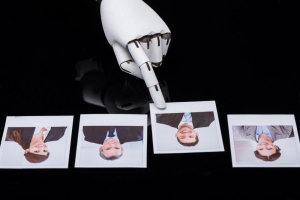
Image of white robotic hand pointing at a polaroid of a man in a suit, with two other polaroids to the left and one to the right. The robot is selecting the individual in the picture they are pointing at.

Algorithms are already in use for recruitment. Some sift through CVs looking for keywords. Others analyse facial expressions and mannerisms during interviews.

Protection from Automated Processing:

Amazon’s experimental engine clearly illustrated how automated decision making can drastically affect the rights and freedoms of individuals. It’s why the GDPR includes specific safeguards against automated decision-making.  

Article 22 states that (apart from a few exceptions), an individual has the right not to be subject to a decision based solely on automated processing. Individuals have the right to obtain human intervention, should they contest the decision made, and in most cases an individual’s explicit consent should be gathered before using any automated decision making.  

This is becoming increasingly important to remember as technology continues to advance. Amazon’s experiment may have fallen through, but there are still AI-powered hiring products on the market. Companies such as Modern Hire and Hirevue provide interview analysis software, automatically generating ratings based on an applicant’s facial expressions and mannerisms. Depending on the datasets these products were trained on, these machines may also be brimming with biases.  

As Data Controllers, we must keep assessing the data protection impact of every product and every process. Talking to wired.co.uk, Ivana Bartoletti (Technical Director–Privacy at consultancy firm Deloitte) stated that she believed the current Covid-19 pandemic will push employers to implement AI based recruitment processes at “rocket speed”, and that these automated decisions can “lock people out of jobs”.

Battling Bias:

We live in a world where conscious and unconscious bias affects the lives and chances of many individuals. If we teach AI systems based on the world we have now, it’s little wonder that the results end up the same. With the mystique of a computer generated answer, people are less likely to question it. 

As sci-fi fantasy meets workplace reality (and it’s going to reach recruitment in schools and colleges first) it is our job to build in safeguards and protections. Building in a Human based check, informing data subjects, and completing Data Protection Impact Assessments are all tools to protect rights and freedoms in the battle against biased AI.  

Heavy stuff. It seems only right to finish with a machine learning joke: 

A machine learning algorithm walks into a bar… 

The bartender asks, “What will you have?” 

The  algorithm immediately responds, “What’s everyone else having?” 


The technologies used to process person data are becoming more sophisticated all the time.

This is the first article of an occasional series where we will examine the impact of emerging technology on Data Protection. Next time, we’ll be looking at new technologies in the area of remote learning.