
If you’ve worked in education for any length of time, you’ve probably experienced the moment.
You’re halfway through a busy day. A colleague asks for some pupil information, a parent requests access to records, an email lands containing sensitive details, and somewhere in the background sits that annual data protection training that you vaguely remember completing a few months ago.
At times like these, data protection can feel like a separate discipline altogether. Something owned by compliance teams, policies, and legislation rather than classroom practitioners.
The reality, however, is quite different.
Every day, educators make decisions about personal information. Whether recording assessment outcomes, discussing safeguarding concerns, managing attendance, communicating with families, or sharing information with external agencies, data protection is woven into the daily life of schools.
The challenge is not learning a set of legal rules. The challenge is understanding how those rules help us make better professional decisions.
That’s where the seven data protection principles come in.
Rather than viewing them as legal requirements to memorise, it’s helpful to think of them as a framework for answering a simple question:
“Am I handling this person’s information in a way that is appropriate, respectful, and responsible?”
Let’s explore what that looks like in practice.
The Seven Data Protection Principles
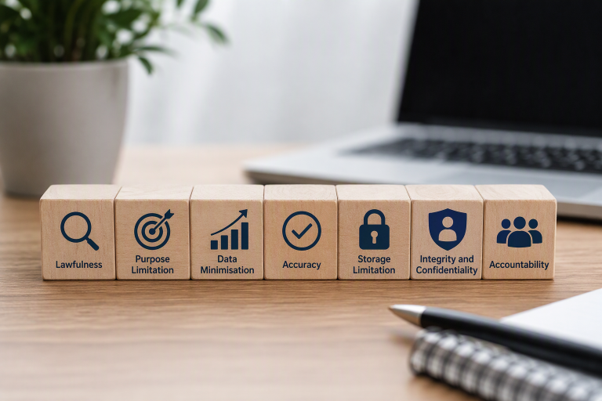
Under UK GDPR, organisations must follow seven key principles:
- Lawfulness, Fairness and Transparency
- Purpose Limitation
- Data Minimisation
- Accuracy
- Storage Limitation
- Integrity and Confidentiality (Security)
- Accountability
On paper, they can appear abstract. In a school environment, however, they become much more tangible.
- Lawfulness, Fairness and Transparency
Let’s start with a familiar scenario.
A parent approaches reception and asks:
“What information does the school actually hold about my child, and why do you need it?”
Would the answer be clear and straightforward?
That’s the essence of this first principle.
Schools should be open about what information they collect, why they collect it, how it will be used, who it may be shared with, and how long it will be retained.
This isn’t simply about meeting legal requirements. It’s about building confidence.
When parents understand why information is needed, they’re more likely to trust that it is being used appropriately.
Educational organisations routinely explain the purpose behind their decisions, whether it’s a homework policy, a curriculum choice, or a behaviour strategy. Data protection is no different.
People deserve to understand what is happening with their information and why.
- Purpose Limitation
Imagine a member of staff develops a survey to understand pupil wellbeing.
The information gathered provides valuable insights, helps identify support needs, and informs pastoral interventions. Everyone agrees it was collected for a worthwhile purpose.
A few months later, someone suggests using the same data for an entirely different initiative.
At that point, it’s worth pausing.
The principle of purpose limitation reminds us that information should be collected for specific, legitimate reasons and not reused in ways that are incompatible with those original purposes.
In practical terms, schools should always be able to answer:
“Why are we collecting this information?”
For attendance data, the answer is usually obvious.
For safeguarding records, assessment information, medical needs, or parental contact details, the purpose is equally clear.
The difficulty often arises when collecting information simply because it might be useful one day.
Data protection encourages us to be more intentional than that.
- Data Minimisation
Education is a profession built on understanding people. Information helps schools and colleges identify patterns, recognise emerging needs, and make informed decisions that support learners. It’s therefore easy to see why organisations can sometimes be tempted to collect more data than they actually need.
But there is an important distinction between useful information and unnecessary information.
I once heard a school leader describe data minimisation as “the digital equivalent of packing for a weekend away.”
Most people intend to travel light.
Most people still arrive with three pairs of shoes, two coats, and a collection of items they never touch.
Schools can sometimes do the same with data.
A simple process gradually accumulates additional fields, additional forms, additional spreadsheets, and additional requests for information.
The principle of data minimisation encourages you to ask:
“Do we genuinely need this information to achieve our objective?”
If the answer is no, you should resist collecting it.
Collecting less information not only reduces risk but also makes systems easier to manage and maintain.
- Accuracy
Anyone who has ever entered data into a management information system knows how easily small errors can occur.
A mistyped phone number. An outdated address. A medical condition that has changed. A record that was accurate six months ago but no longer reflects reality.
Accuracy might sound like a technical requirement, but in education, it often has very human consequences.
Imagine trying to contact a parent during an emergency only to discover the details on file are wrong. Or imagine making a decision about pupil support based on outdated information.
Suddenly, accuracy becomes much more than a data quality issue. It becomes a safeguarding and wellbeing issue.
Good data protection reminds us that personal information should be reviewed regularly and corrected when necessary.
Reliable decisions depend on reliable information.
- Storage Limitation
Most schools have a cupboard, filing cabinet, or shared drive that contains resources nobody has looked at for years.
Some records remain because they are required; while others remain because nobody quite knows whether they can be deleted.
The storage limitation principle encourages schools to think more carefully. Information should not be retained indefinitely simply because storage space exists.
Instead, schools should understand:
- Why information is being kept
- How long it needs to be retained
- When it should be securely disposed of
A helpful way of thinking about this is to imagine every record being accompanied by a small question:
“Do you still need me?”
If the answer is no, retention practices should ensure the information is appropriately removed.
Good record management is not about keeping everything. It’s about keeping what matters for as long as it matters.
- Integrity and Confidentiality (Security)
When people hear the phrase data breach, they often imagine a sophisticated cyberattack.
Certainly, cyber threats are real, and schools must take them seriously. Yet many data incidents arise from far simpler situations.
An email sent to the wrong recipient.
A confidential document left on a printer.
A discussion about sensitive information taking place where others can overhear.
A laptop left unlocked.
The reality is that information security is often less about technology and more about habits.
Every educator develops professional routines. We take registers, monitor safeguarding concerns, and adapt lessons based on pupil need.
Strong data protection requires similar routines:
- Locking devices when unattended
- Using strong passwords
- Verifying recipients before sending information
- Storing records securely
- Sharing information on a need-to-know basis
These actions may seem small in isolation, but collectively they create a culture of security.
- Accountability
The final principle is perhaps the one that connects all the others.
Imagine an inspector, governor, parent, or regulator asks:
“How do you know your school handles personal information appropriately?”
Accountability means being able to answer that question with evidence.
Not simply saying:
“We take data protection seriously.”
But demonstrating it through:
- Policies and procedures
- Staff training
- Privacy notices
- Risk assessments
- Governance arrangements
- Incident reporting processes
For educators, this concept should feel familiar.
We’re accustomed to evidencing teaching, learning, assessment, and safeguarding practice.
Data protection follows the same logic. Good intentions are important, but evidence of good practice matters too.
The Principle Behind the Principles
Whenever data protection is discussed, conversations often drift towards compliance.
Policies. Audits. Forms. Training modules.
Necessary though these things are, they can sometimes distract from the bigger picture.
At its heart, data protection is about trust. Parents trust schools with sensitive information about their children. Pupils trust staff with personal concerns. Employees trust their organisations with professional and personal records.
Every decision about personal information either strengthens or weakens that trust.
Perhaps that’s why the seven principles remain so relevant. They’re not really about data. They’re about people.
They encourage us to pause before collecting information, sharing it, storing it, or disposing of it and ask:
“Am I handling this information with the same care and respect I would expect for my own?”
When educators adopt that mindset, the principles become less about compliance and more about professionalism.
The seven data protection principles are not isolated legal concepts to revisit once a year during mandatory training. They are practical guides that support everyday decision-making in schools.
By ensuring information is used lawfully and transparently, collected for clear purposes, limited to what is necessary, kept accurate, retained appropriately, secured effectively, and managed accountably, schools create environments where personal information is treated with the care it deserves.
And ultimately, that is what good data protection has always been about: not protecting data for its own sake but protecting the people behind it.